Sealed System and Compressor Repair in Waldorf, MD
Sealed System and Compressor Repair in Waldorf, Maryland, with the published national price range up front, the failed part confirmed by testing on site, and the repair price stated before any work begins.
Sealed System and Compressor Repair in Waldorf, MD by Waldorf Appliance Repair
A refrigerator that runs all day and still loses ground on temperature is often telling you about its sealed system. That loop — compressor, evaporator, condenser, and the refrigerant lines joining them — is what moves heat, and when it weakens, no thermostat setting will save the groceries. At Waldorf Appliance Repair, we confirm sealed system trouble with pressure, temperature, and frost pattern readings before recommending anything, because this repair should never rest on a guess.
What the Sealed System Does, and How It Fails
The compressor squeezes refrigerant gas through the condenser coils, where heat leaves the cabinet. The refrigerant then passes to the evaporator, absorbs heat from both sections, and returns to the compressor. Every joint is sealed at the factory — where the name comes from — and the measured charge has to stay inside for cooling to work.
Failures show up in recognizable ways. A compressor that clicks on and off every few minutes is often shutting down on overload protection. Frost covering only the evaporator's first part, instead of a light, even coat, points to a weak charge or a weakening compressor. None of those signs closes the case by itself, though. Dusty coils, a failed fan, or a defrost fault can imitate sealed system trouble, and each is a smaller repair, so testing comes first: current draw, pressures, and temperatures.
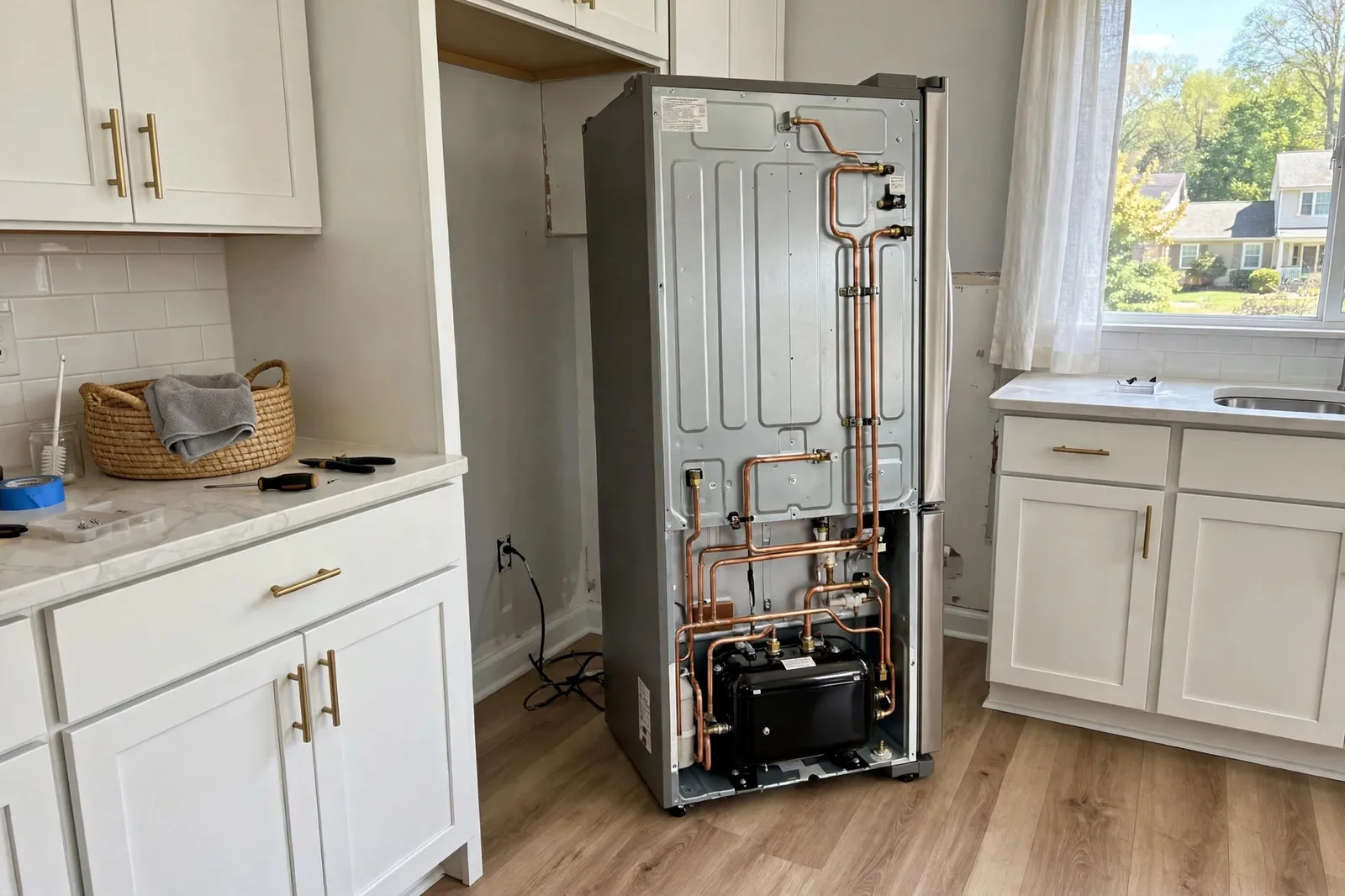
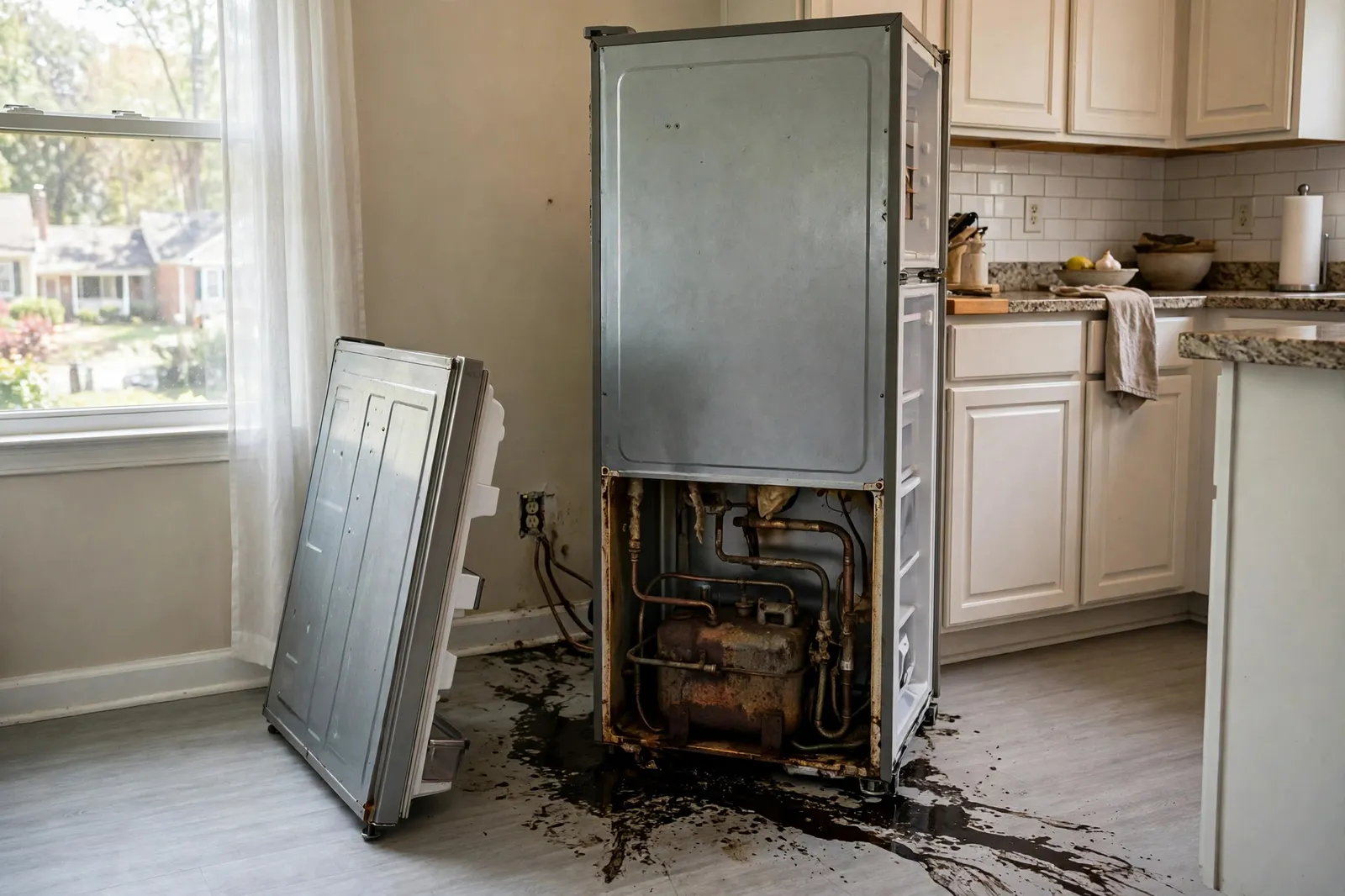
Recent Project: Compressor Replacement on a Carrington Side-by-Side
BEFOREAFTER
A side-by-side refrigerator in a Carrington home had crept into the mid-forties on the fresh food side, its compressor running almost without pause. Testing showed the compressor drawing high current and dropping out on overload, with frost on only the evaporator's first passes. We replaced the compressor and filter drier, pulled a deep vacuum, weighed in a fresh charge, and confirmed both sections at temperature.
Turnaround
About six hours on site
Final Price
$465
Sealed System and Compressor Repair Cost in Waldorf, MD
No Waldorf shop publishes a local price list, so we publish the national figures openly. Angi's 2026 data puts a typical refrigerator repair at $200 to $300 and freezer repair from $90 to $500, and sealed system work sits at the top of those ranges, because the job takes hours — published national labor figures run $50 to $150 per hour — and uses the appliance's most involved parts. The average repair nationally is about $170, per Angi — a compressor job is not an average job.
That is why the repair-versus-replace conversation happens before any work starts. A sound refrigerator with years ahead of it can justify this repair; a machine deep into its expected life often cannot, and we will tell you plainly when replacement is the better use of your money.
How We Handle a Sealed System Call
Every job begins with the quote form at the bottom of this page: name, phone, brand, and model number. On site, we test before opening anything — a sealed system is only opened when the evidence says the fault is inside it. Parts go in matched to the model, the system is evacuated and charged by weight, and temperatures are confirmed before we call it finished.
Request an Appliance Repair Quote in Waldorf, MD
Use the quote form at the bottom of this page and tell us which refrigerator or freezer is struggling and what it is doing: running constantly, clicking, or warming up. We will respond with the published range for your repair and the next step.
Frequently Asked Questions
What exactly is the sealed system in a refrigerator?
It is the closed loop that moves heat out of the cabinet — compressor, condenser, evaporator, and refrigerant lines — holding a measured charge. When a part inside weakens or the charge leaks away, cooling stops even though fans and lights still work.
How much does sealed system or compressor repair cost?
Angi's published national figures put typical refrigerator repair at $200 to $300 and freezer repair at $90 to $500, with sealed system work at the top of those ranges. Most repairs average about $170, per Angi; a compressor replacement is a larger job. Send the quote form for the range that fits your machine.
What are the signs a compressor is failing?
Common signs: a refrigerator running nearly nonstop while warming up, a compressor clicking on and off in short cycles, a hum ending in a click, and frost on only part of the evaporator coil. Dirty coils or a failed fan can look similar, which is why testing comes first.
Is it worth replacing a compressor on an older refrigerator?
It depends on age and condition. On a refrigerator with good seals and years of life left, a compressor repair can be money well spent. On a unit past its typical lifespan, the same money is often better put toward replacement — a comparison we will walk through with you first.
How long does a sealed system repair take?
Several hours, typically: the old component comes out, the system is evacuated, the new charge is weighed in, and the machine runs long enough to prove it holds temperature.
Do you repair sealed systems on freezers as well?
Yes. Chest and upright freezers use the same sealed loop, and we repair compressors, evaporators, and refrigerant lines on both. A warm freezer also deserves a look at its door seal: a leaking seal in a humid Charles County summer can run a healthy compressor to death.
Get Your Appliance Repair Quote
Tell us which appliance is down and what it is doing. We read every request that comes in and respond with the published national range for that kind of repair and the next step, starting with a visit to test and confirm the failed part on site.
Prefer to talk it through first? Send the form and we will call you back at the number you give us.